It was 2014. I sat in that meeting with my colleagues in Berlin Mitte and my nervous system was doing overtime.
Not the arguments — though I was tracking those, sharp and fast, too. What I was actually metabolising was everything underneath. The unspoken agendas. The way a particular silence followed a particular name. The slightest shift in posture. The tone of voice.
I was reading the field. And I felt pretty alone doing so.
What I know now, looking back at a younger version of myself in that room: I had developed a very fine capacity to sense what was happening — and an almost equally sophisticated habit of not saying it. Absorbing the signal. Never transmitting it back.
Too much intake. Not enough output. The field was moving through me, and then staying there.
Today, I see it everywhere I look.
Why your leadership isn't landing — and it's not about your message
We are living through a moment that has no single name because it contains too many crises at once. Ecological. Political. Institutional. A kind of complexity that compounds. And in the middle of it, in every organization, every family, every community, there are leaders — us — making decisions.
Most of them are disconnected from the field they're supposed to be navigating.
Not because they lack intelligence or information. Because they've been trained to lead from abstraction rather than from attunement. To trust the slide deck over the nervous system. To mistake the map for the territory — and the meeting room for a safe, legible space where rational arguments produce predictable outcomes.
Meanwhile, the room is saying something. The team is saying something. The moment is saying something.
And no one is listening. Not really. Not with their whole body in the game.
What disconnected leadership actually looks like — and what it costs
The pattern I see most often isn't arrogance or incompetence. It's dissociation. Leaders who are physically present but energetically elsewhere — processing content while missing context, speaking into a room they haven't actually read.
Decisions get made from the stated agenda rather than the real one. Talent quietly disengages because they feel managed, not met. Strategy lands on paper but doesn't move people. The gap between intention and impact widens, and nobody can quite name why.
I was there countless times, and still catch myself doing this.
And the higher the complexity — the more volatile the environment, the more divergent the stakeholders — the more expensive that disconnection becomes. In a polycrisis, the leaders who navigate well aren't the ones with the best frameworks. They're the ones who can feel what's actually happening and respond from their full instrument.
The leadership skill nobody teaches: reading the room with your whole body
The leaders I most admire — the ones who seem to move through complexity without being crushed by it — share something that isn't on any competency framework I've ever seen.
They are present to the field.
They read what's alive in a room before they speak. They sense where the real obstruction is — not the stated one. And when they do speak, they speak with precision. Not volume, not authority, not charisma.
Precision.
They've calibrated. Inner state. Outer signal. The gap between what they carry and what they transmit — closed.
That calibration doesn't happen by accident. And it doesn't happen through more strategy.
It happens when a leader is willing to do something most development programs never ask of them: to stop performing leadership and start inhabiting it.
This is what I call Field Leadership.
Field Leadership is the capacity to read the invisible architecture of a group and the field inbetween — and shape it. Not through authority or strategy, but through the coherence of your presence.
Most leaders feel the field. Few transmit back into it. Something stops them — a freeze that lives below conscious decision, in the nervous system itself. Field Leadership is the work of unfreezing: so what you sense actually moves through you, and into the room.
Your energy is the infrastructure: what field leadership actually means
What does that actually mean?
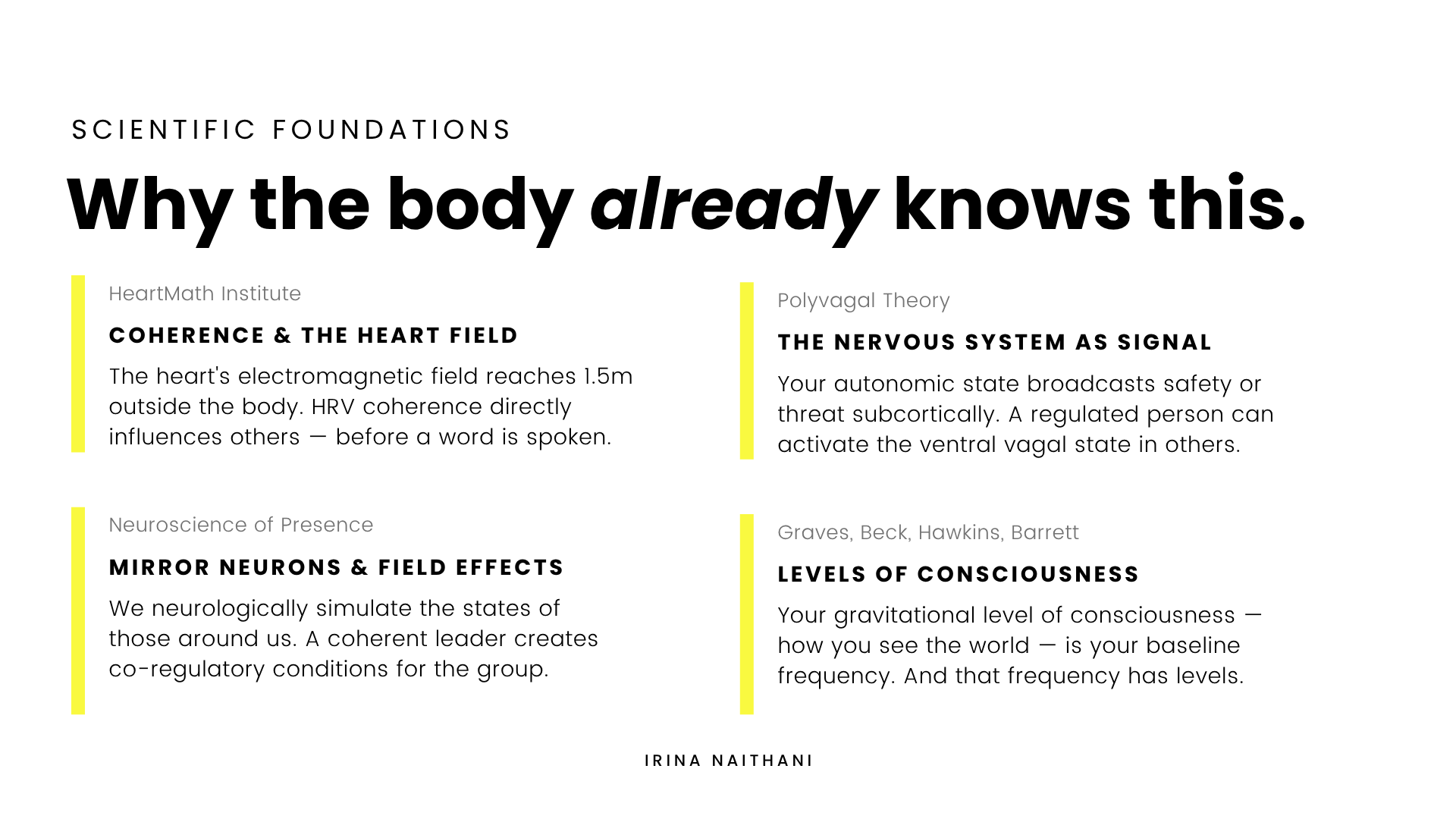
It means your energy — the actual quality of presence you bring into a room — is not a soft add-on to your leadership. It is the infrastructure. People feel your nervous system before they process your words. They read your signal before they evaluate your argument. The coherence between your inner state and your outer expression either opens the field or contracts it.
This is not mystical. It is measurable. Research in polyvagal theory, HeartMath coherence, and mirror neuron science all point to the same thing: your inner state is always broadcasting. The question is whether you're broadcasting intentionally — or by auto-pilot.
And it is developable. That's the part most people miss.
The world doesn't need more leaders who have more answers. It needs human beings who can be in the room — fully, honestly, without dissociating into strategy or spectacle. Leaders who can read what's actually happening in a group — in a family, in a company, in a community — and respond from their full instrument, not just their prepared position.
Leaders who have done... enough inner work that their signal is clean. Who have enough range that they can meet the moment, whatever it asks. Who have enough identity beneath them that they don't lose themselves in complexity. Instead, they navigate from it.
This is what I mean when I talk about leading with energy. Not performing aliveness. Not optimizing your presence for effect.
Inhabiting yourself so completely that your leadership becomes a genuine transmission — something that leaves the field different because you were in it.
From absorbing to transmitting: the shift that changes everything
The meeting I described at the beginning? I eventually found my voice. Not by learning to speak louder or argue smarter. By leaning into what I was already sensing and transmitting it back, precisely, with the full weight of my presence behind it.
How to begin that shift — from absorbing to transmitting?
- Own your energy. Not for performance — for real presence and alignment.
- Sharpen your signal. Not for influence as leverage — for the kind of communication that actually lands, that changes what becomes possible.
- Unleash your core. Because the leaders who shape the next decade won't be running on borrowed identity. They'll be leading from an interior that is genuinely their own.
The room is always saying something. So is this moment in history.
A polycrisis doesn't resolve through better frameworks. It asks for something older and more precise: human beings who are actually present to what is happening. Who can feel the real obstruction beneath the stated agenda — the grief, the fear, the unspoken longing for coherence. Who are regulated enough to activate safety in others — not because they carry all the answers, but because they haven't left the room. Because their nervous system is still online, still listening, still willing to be moved by what the field is asking.
Field Leadership isn't a methodology you apply to complexity. It's a quality of being that complexity can move through. A living architecture of attention, attunement, and transmission that allows the real signal to surface — in you, through you, and between the people you are called to lead.
The room is always speaking. The question is whether you have developed the capacity to hear it beneath the noise of your own urgency. Whether you have the courage to respond not from a script, but from the truth of what you sense. Whether you are willing to become the kind of leader whose presence alone reorganizes what is possible — because you have done the inner work that makes your signal unmistakably, irreducibly real.
What is your signal broadcasting right now — and is it what you intend?